About this calculator
Dry pouring (or "pour-and-soak") means dumping bagged concrete mix into your forms dry, screeding it level, then wetting it with a fine spray over a few hours instead of mixing first. This calculator gives you the bag count to buy. Enter the slab's length, width, and thickness, pick a bag size, and it sizes the order with a waste allowance. Before you start, it's worth knowing whether dry pouring is right for your project: it's fine for small, non-structural pads but weaker than properly mixed concrete. The guide below breaks down when it works and when to mix wet instead.
How the math works
Dry pour uses the same volume math as any slab: length × width × thickness in feet gives cubic feet, divided by the bag's yield (an 80 lb bag ≈ 0.60 cu ft, a 60 lb ≈ 0.45, a 40 lb ≈ 0.30) and rounded up, with a waste allowance added. There's no mixing step, so the bag count is the whole material list. But the trade-off is less control over water and strength, which is why dry pour is best kept to thin, small, non-structural pours.
Common questions
Does dry pour concrete actually work?
For small, non-structural pours, like stepping stones, a shed-corner pad, or fence-post collars, yes, well enough. It cures weaker and less evenly than mixed concrete, so it's not for driveways, footings, or anything load-bearing or reinforced. The dry pour guide linked below covers the full pros and cons.
How many bags do I need to dry-pour a slab?
It's the same volume math as any pour. A 6×6 ft pad at 4" is about 12 cubic feet, roughly 22 eighty-pound bags with a waste allowance. Enter your own dimensions above for an exact count.
How thick can you dry pour concrete?
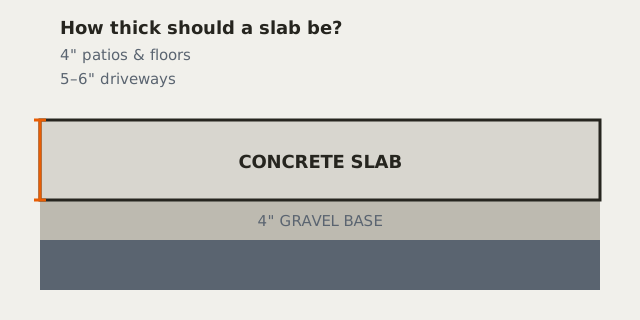
Keep it thin, about 2 to 4 inches. Water has to soak all the way through to hydrate the mix, and thicker dry pours tend to stay powdery and weak in the middle.