Concrete is strong in compression but weak in tension, so it cracks when something tries to bend or pull it apart. Reinforcement handles those tension forces. Whether you need it comes down to load and thickness.
When concrete needs rebar
Use rebar for structural and load-bearing concrete: driveways, garage floors, footings, foundation walls, and any slab 4 inches or thicker that carries real weight. Rebar holds the slab together when the ground shifts and keeps cracks from spreading.
When you can skip it (or use an alternative)
Thin, non-structural flatwork, like a 4-inch garden path or a small patio on stable ground, often does fine without rebar. Common alternatives: welded wire mesh for crack control in slabs, and fiber mesh (mixed into the concrete) for light-duty surface crack resistance. Many slabs use mesh or fiber instead of, or alongside, rebar.
Typical rebar spacing
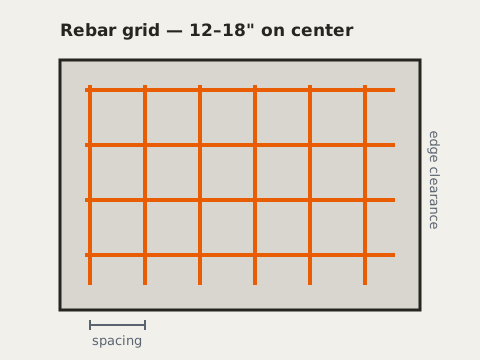
A common residential grid is #3 or #4 bar at 12 to 18 inches on center both directions, kept about 3 inches from the edges and lifted to mid-slab on chairs. Your exact grid depends on load and code. The rebar calculator turns slab size and spacing into the bar count and weight to buy.
Common questions
Does a 4 inch slab need rebar?
If it carries vehicles or heavy loads, yes. For a small, non-structural 4-inch slab on solid ground, wire mesh or fiber is often enough.
Rebar vs wire mesh: which is better?
Rebar gives more structural strength for driveways and footings; welded wire mesh is simpler crack control for lighter slabs. Heavy or load-bearing work uses rebar.
How far apart should rebar be in a slab?
12 to 18 inches on center is typical for residential slabs, set in a grid and kept off the subgrade. Use the rebar calculator for an exact count.